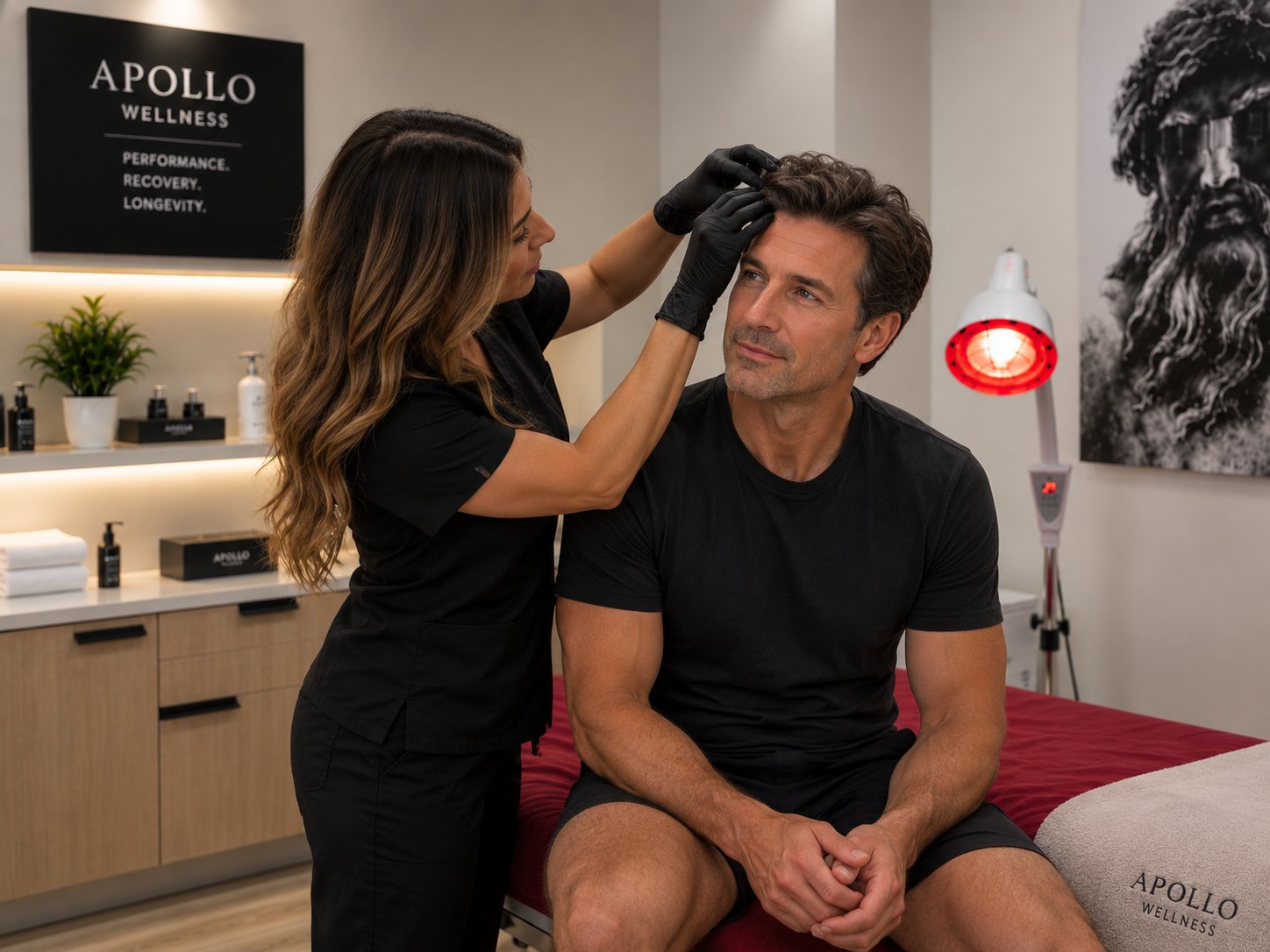
Hair Restoration for Men
Keep what you have. Rebuild what you can.
Thinning at the crown, a hairline creeping back, more scalp showing under the bathroom light. Male pattern hair loss is common, but it doesn't have to be accepted. The earlier you act, the more there is to save. At Apollo Wellness Miami, your plan starts with your bloodwork, not a one-size-fits-all prescription.
Medical evaluation · Hormone and lab work · Provider-guided plans
The Cause
What's Actually Behind It
Most male hair loss comes down to DHT, a hormone your body makes from testosterone. In men who are genetically sensitive to it, DHT gradually shrinks hair follicles until they produce thinner, weaker strands and eventually stop.
The good news is that this process can be slowed, stopped, and in many cases partially reversed with the right treatment and consistency.
Treatment
Your Treatment Options
Proven medical foundation. Finasteride and minoxidil are the two FDA-approved treatments for male pattern hair loss. Finasteride works on the root cause by lowering DHT. Minoxidil works at the follicle to support growth. Many men get the best results using both together.
Advanced and supportive therapies
PRP (platelet-rich plasma). This uses growth factors from your own blood to support the scalp.
Peptide therapy (such as GHK-Cu). These support scalp health and the hair environment.
Nutrient support. This addresses gaps in vitamins and minerals your hair depends on.
Every add-on is recommended based on your evaluation, not bundled by default.
Hormones
On TRT? This Matters.
Testosterone therapy and hair loss treatment are connected. Raising testosterone can also raise DHT, and finasteride works by limiting that conversion. Research suggests the two can be used together safely, but they should be managed together, with one provider seeing your full hormone picture.
At Apollo, your hormone care and hair restoration live under one roof, so nothing gets managed in a vacuum.
Telehealth vs. Apollo
Why Not Just Order It Online?
Telehealth apps can mail you a prescription. What they can't do is look at your labs, account for your hormone therapy, or adjust your plan as you go. You get a questionnaire. With us, you get a provider who knows your whole story.
The Process
How It Works
01
Consultation.
We talk through your history, your goals, and the pattern of your hair loss.
02
Lab work.
We establish your hormone baseline, including testosterone and other relevant markers.
03
Your plan.
A custom treatment plan is built around your results, with side effects discussed upfront.
04
Ongoing monitoring.
We check in regularly, track progress, and make adjustments when needed.
Hair Restoration for Men
Your Questions, Answered
Hair Loss on GLP-1s
Your weight loss is working. Let's make sure your hair keeps up.
You're down sizes, your energy is back, and then you start seeing more hair in the shower drain. It's one of the most common concerns we hear from GLP-1 patients in Miami. The good news is that it's usually explainable and often temporary. The key is knowing what's actually driving it.
Book Your Consultation- Medical evaluation
- Targeted lab work
- Ongoing support
The Timing
Why It Happens Later Than You'd Expect
Hair doesn't react in real time. Each strand moves through a cycle of growing, resting, and releasing, and a big change in the body can push more strands into the resting phase all at once. That shedding usually doesn't show up until two to four months later. This condition is called telogen effluvium.
So the hair you're losing today is often a response to something that happened weeks ago, like a dose increase, a sharp drop in calories, or simply losing weight quickly. That delay is why so many people never connect the dots.
The Causes
It's Rarely Just One Thing
It's easy to blame the medication, but the full picture usually includes several overlapping factors:
Pace of weight loss. Faster drops put more stress on the body.
Eating less overall. Lower appetite can mean falling short on protein, iron, zinc, and key vitamins your hair depends on.
Hormones and thyroid. These are worth checking, especially during big body changes.
Genetics. Pattern thinning you already had can become more noticeable during a shedding phase.
Stress and sleep. These play a bigger role than most people think.
Hair loss has been reported with GLP-1 medications, but how much is caused by the medication itself versus everything around it varies from person to person. That's exactly why we evaluate instead of guessing.
Our Approach
Don't Quit Your Progress. Get Answers.
Stopping a treatment that's working, without understanding the cause, can trade one problem for another. Our approach keeps your weight-loss plan on track while we figure out what's happening with your hair.
Here's how we approach it:
01
Review your timeline.
When you started, dose changes, and when the shedding began.
02
Run targeted labs.
Iron, thyroid, vitamin levels, and hormones as appropriate.
03
Look at your nutrition.
Especially protein intake while your appetite is lower.
04
Assess the pattern.
Diffuse shedding and pattern thinning call for different strategies.
05
Build your plan.
Adjust pacing, fill nutritional gaps, and add supportive therapies where they make sense.
Many patients see shedding settle once the trigger stabilizes. If something else is going on underneath, we'll identify it and address it directly.
Hair Loss on GLP-1s
Your Questions, Answered
Hair Loss on GLP-1s
Look Good. Feel Good. Keep Your Results.
Apollo Wellness Miami brings weight loss, lab work, and recovery support under one roof, with real providers and plans built around your body.
Hair Restoration for Men
Confidence Starts at the Top
Apollo Wellness Miami combines hormone care, lab-driven treatment, and real providers to help you look and feel like yourself again.
This page is for general information only and is not medical advice or a diagnosis. A licensed provider will determine whether treatment is appropriate. Individual results vary. Compounded medications are not FDA-approved.
This page is for general information only and is not medical advice or a diagnosis. A licensed provider will determine what's appropriate for you. Individual results vary.